As of 2026, when AI and other new-gen technologies are constantly booming, the U.S. Bureau of Labor Statistics stated in a report that overall employment for software and web developers is projected to grow between 7% and 17% through the 2030s.
It means that if you are looking for a career opportunity that pays well, provides you with a good work environment at top companies, and assures sustainable growth, then nothing could be better than becoming a full-stack developer. Find what skills are needed, the latest tools, trends, and the overall roadmap to kickstart your journey in this article. Understanding what web development involves can also help you see how full-stack development fits into the wider technology field. Businesses looking to build scalable digital platforms can also explore website development services to support their technical requirements.
- What Is a Full Stack Developer?
- Front-End vs Back-End vs Full Stack Developer
- Essential Skills Every Full Stack Developer Needs
- Popular Full Stack Technology Stacks
- Benefits of Becoming a Full Stack Developer
- Challenges of Being a Full Stack Developer
- How to Become a Full Stack Developer?
- Is Full Stack Development a Good Career?
- Common Mistakes Beginners Should Avoid
- Frequently Asked Questions (FAQ)
- Conclusion
What Is a Full Stack Developer?
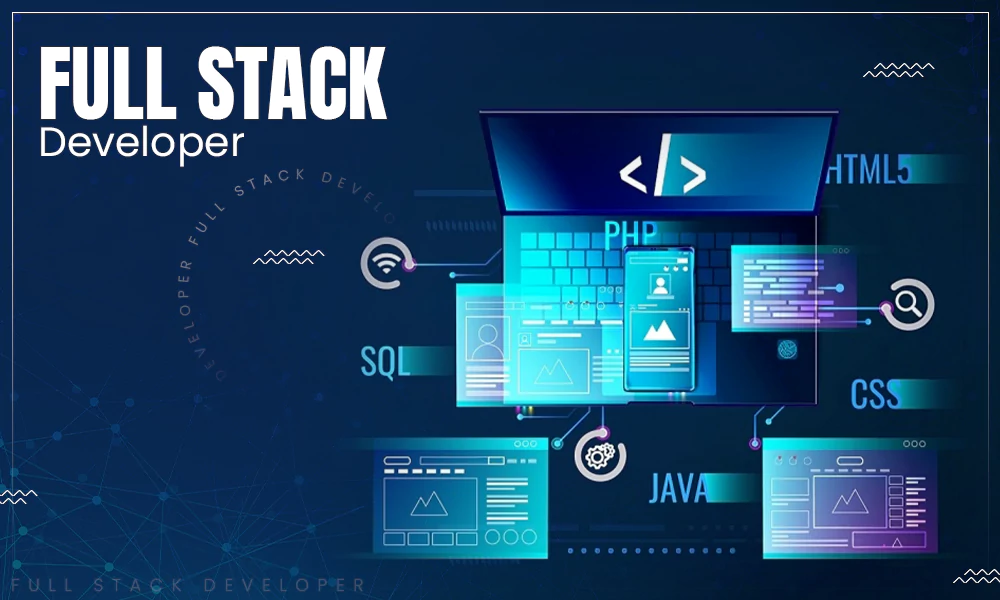
A full-stack developer is a programming professional who can build websites and applications, secure databases across various online units, and improve the architecture of coding layers across front-end (client) and back-end (server-based) frameworks.
In simple terms, everything you see and don’t see on the website is built by the collective effort of these professionals as they curate both UI and UX designs of an online framework along with the database where data is stored and utilized. This also means understanding the web design process can be valuable when working across the different layers of a website.
Front-End vs Back-End vs Full Stack Developer
Before moving forward, you first need to understand the basic difference between front-end, back-end, and full-stack developers so that you can easily decode the full stack developer meaning in IT firms.
| Feature | Front-end | Back-end | Full-stack |
| Core languages | Focuses on HTML, CSS, and JavaScript for functionality. | Node.js, Python, Java, and PHP are the main languages used for building frameworks. | Requires development for both back-end and front-end websites. |
| Goal | Major focus on user interface. | Prime usage in making servers and databases. | Combines both tasks in one unit. |
| API Development | Not too much room for API development. | Can develop API bots and encrypted features. | Can develop API bots and encrypted features. |
Essential Skills Every Full Stack Developer Needs
Today, due to robust competition and ever-growing tech trends, there is also an increase in the demand in skillset of full stack development because of new algorithms empowered by artificial intelligence and machine learning technologies. That’s why below we have presented a complete walkthrough of what is full stack toolkit you need in 2026.
- Front-End Development Skills: If you are a beginner and want to kick-start your career here, then the first thing you have to learn is front-end skills, which include UI/UX development, WordPress, and a coding language like JavaScript to make creative elements that appeal to the audience and fulfill the client’s theme requirements.
- Back-End Development Skills: Next, focus on building good back-end skills, which are necessary for creating frameworks like databases, security encryption, servers, and platforms that can sustain and deploy your designs.
- Database Knowledge: Managing and creating databases using SQL and other languages is also highly needed in this field because that’s how you will manage the traffic and improve the scalability of the platforms according to the needs of users or clients.
- API Development: Today, people rely on chatbots, icons, and lucrative CTA for registration and adding credentials, which has become an essential element of web design that shouldn’t be ignored. Learn how to create an API using different AI-based coding methods for faster creation and implementation.
- Deployment: After learning all these skills, learn how to deploy and manage your software platform according to its specific needs and maintain its coding frameworks to establish longevity.
Developers working on websites should also understand how to make a website mobile-friendly because users may access projects from a wide range of devices.
Read more: Website Redesign: The Complete Guide to Planning a Successful Website Revamp
Popular Full Stack Technology Stacks
Full-stack development requires some of the most important technologies to be fully executed and maintained for the long term. Some of the most popular ones that almost every DevOps uses in their framework are
- MERN Stack: MERN Stack is a JavaScript technology that is used primarily for creating dynamic interfaces and fixing bugs present in the internal coding framework using technologies like MongoDB for data, Express.js, and Node.js.
- MEAN Stack: When developers need rapid outputs, they primarily use the MEAN stack, as it can create immersive solutions and frameworks using short code patterns with the help of components like MongoDB, Express.js, Angular, and Node.js.
- LAMP Stack: LAMP Stack is also an expansive open-source coding program where you can create large-scale projects with a high volume of elements, as it is powered by Linux, Apache, MySQL, and PHP.
- Django Stack: Django Stack is a Python-based framework used for creating responsive portals, web protocols, and servers by using React, Vue, Angular, or Next.js.
Benefits of Becoming a Full Stack Developer

As you learn all of these skills and master new technologies, no one can stop you from becoming a full stack developer, which is absolutely amazing because this profession has so many perks like
- High-paying jobs at the start of your career, ranging from $30 to $40K per month, along with benefits like a hybrid work environment, project-based incentives, and high-end systems to improve your productivity.
- Exposure to big firms like Apple, Google, or Amazon through internships or career-based programs, which improves your overall skill set and opens gateways for global opportunities.
- You can also work on freelance projects when you are idle from work or during the “looking for opportunity” phase and can easily earn up to $5-$10K per client project.
- In this profile, professional growth is predictable and active because, due to its high demand and low volume of applicants, those who are really performing well get easily noticed by big companies across the world.
- As you work on the front and the back end of the application or the website, there are very low chances of communication barriers or negligence of important elements; that’s why your output becomes more refined, and companies value this trait so much.
Read more: Best Web Hosting Services in 2026: Tested, Compared & Ranked
Challenges of Being a Full Stack Developer

Seeing the benefits above, you might be thinking it’s a very easy journey to becoming a full stack developer, but the reality is you have to deal with some ups and downs. Here we have listed some challenging aspects that you might face if you neglect the basics.
- Challenge 1: As you know, technology is constantly evolving, and keeping up with it sometimes becomes very time- and effort-consuming, which is why so many novice developers face problems like mental fatigue, FOMO, and constant anxiety while learning full stack skills.
- Challenge 2: Full stack development demands consistency in both front-end and back-end development, but not every person is good at both. There are so many individuals who suffer from the problem of being inconsistent in one domain and mastering the other; while this can be fixed over time, during the initial phase, devs feel devastated.
- Challenge 3: In the initial days of a full stack career, it is often found that many full stack interns fail to deliver high-volume projects before deadlines because their aspirations are quite high. The starting package of $30-$40K might seem impressive, but the workload they have justifies it.
- Challenge 4: Data breaches and malicious activity are at an all-time high in 2026 due to readily available internet technologies, and that’s what frustrates full-stack developers the most. Professionals in this field are responsible for protecting and improving SQL frameworks, and if any negative third-party intrusion happens inside the databases, then they become the first responsible for this.
- Challenge 5: Finding bugs and completing debugging is a very hectic process that every full stack developer (whether beginner or experienced) faces because they are stuck between multiple layers of coding architecture, APIs, plugins, themes, and many more places, which makes their identification harder.
How to Become a Full Stack Developer?

Becoming a full stack developer is not a complicated task, but it surely requires a lot of time, effort, trial and error, and patience, which is necessary to develop critical thinking abilities and command a skill set. You can simply read these eight steps below to understand the complete format of becoming a full-stack developer.
Step 1: Learn HTML & CSS
HTML and CSS are the core of overall web development, as HTML can make expansive web pages while CSS can make themes, layout, and containers, which complete the design of an online portal. Learning these two languages is the foremost thing you should do if you want to pursue a career in full-stack development.
Step 2: Master JavaScript
JavaScript is a beginner-friendly coding language that is used for making immersive web designs, applications, and back-end frameworks, which is why adopting it is not a choice but a necessity today. Without mastering JavaScript, you can get a backseat in the competition, as it comes in basic full-stack developer requirement. Developers can also benefit from understanding professional web design services and how they translate technical skills into user-focused experiences.
Step 3: Learn a Front-End Framework
Adapting to a front-end framework and creating new designs is a must-have skill in 2026 for all upcoming developers, as there are so many who are looking to improve their website aesthetically according to trends. After mastering languages like JavaScript, HTML, or CSS, you can make a lot of utilities and programs and embed them to make your projects or clients’ platforms better than ever before.
Step 4: Learn Back-End Development
Back-end development is another vital element of full stack procedure, as here you have to learn and optimize the coding framework of an application or a website portal to make it ideal according to requirements. You can enhance the back-end utilities by fixing their security parameters, removing unwanted or data-threatening bugs, and fixing glitches that are ruining or stopping the front-end practices. This way, you can unlock the potential of making new web programs or upgrading the existing ones.
Step 5: Learn Databases
Database management and optimization are some of the most conventional units of IT that need good talent in their arsenal, which is why you should get your hands on SQL (Structured Query Language) and cloud-based architecture so that you can effectively improve their algorithm and security parameters. This skill alone has the potential to give you the tag of a full-stack developer and make you noticed by global recruiters at the beginning of your career.
Step 6: Learn Git & GitHub
Learning the practical concepts of Git and GitHub is an essential part of your full-stack developer journey because this tool allows you to make, identify, and share changes in your coding framework in the snap of a finger. Git is a version control tool that works alongside GitHub, which is a platform where you can create anything from data using your mastered coding languages.
Step 7: Build Real Projects
Building real projects instead of campus assignments or demo websites gives you more exposure in the industry because working with real clients will help you understand the contemporary metrics no textbook can ever tell. For example, developers working on online stores may need to understand the requirements handled by an e-commerce website development company to create scalable and user-friendly shopping platforms. So, try to find clients or look for remote internships where you can work on establishing a framework and deploy more utilities using your preferred coding languages, which directly connects with the audience.
Step 8: Learn Deployment
The final phase requires the deployment of all your projects to partial cloud servers or the public domain to ensure their visibility, stability, performance, and sustainability. This way, you can showcase your capabilities to recruiters and even to the whole internet, which can open new gateways for high-paying jobs. Remember, after deployment, monitor all the code and their functioning regularly to optimize it as per requirements.
Is Full Stack Development a Good Career?
Absolutely yes, full stack development is a very good and one of the most highly in-demand career options of 2026, as there are so many global firms like Google, Meta, Amazon, etc are readily hiring for this job profile.
All you need is a good command of overall coding skills, database management capabilities, and experience on a decent project to land your ideal opportunity. The base-level salary on this profile starts around $30,000 to $75,000 and can range up to $120,000 to $300,000 with increasing experience and trends.
Common Mistakes Beginners Should Avoid
Before ending this topic, let’s discuss some common mistakes that you should always avoid as a beginner in the journey of becoming the industry-leading full stack developer:
- Fear of Missing Out: In every sector of the market, there is robust competition for acquiring high-paying jobs because placements are limited and the choices of young talent are infinite. That’s why getting anxious or feeling depressed after seeing your rivals won’t get the job done; instead, it will make things worse. Simply observe their tactics, learn their execution, and implement those findings in yourself to become a better version.
- Too much learning: Sometimes you can become your worst enemy by giving your brain so much stress from learning too many coding languages at once. You see, every coding language has a different framework, and trying to digest so much information in a short period will create too much chaos inside your head. The best thing you should do here is try to master one language first, then hop on to the next one; this way, you will slowly learn all the needed utilities for becoming a full-stack developer.
- Neglecting to Verify the Code Quality: Another sad thing is that some students never try to verify or improve their code quality in their initial phase of learning and thus face severe consequences in the journey, like corrupted output or failed servers. Always try to refine your code writing, notice minor gaps or spaces, and input accurate symbols, as all these things create a good quality product.
- Not Creating a Portfolio/Catalog: Whenever you go for an interview, you will be asked to show all your previous projects, which will be the showcase of your evolution and loose ends that need to be improved. Reality is, if you have not made any record of your creations, then no matter how skilled you are or what achievements you carry, your selection becomes critical.
- Avoiding Daily Practice: Coding is a skill-based practice, not acquired knowledge that is predefined, and ignoring daily practice of your skill might give you a setback in the competition. There are so many individuals in the code community who are giving their all every day just to get noticed by a big firm; that’s why, to stay consistent, you need practice. For larger organizations, full-stack developers may also work alongside an enterprise web development company when projects involve complex integrations, large-scale applications, advanced security, or long-term scalability.
Frequently Asked Questions (FAQ)
What is a full stack developer?
A full stack developer is a type of programmer who can build website projects, protect databases, and improve the architecture from both front-end (client) and back-end (server-based) frameworks.
What is full stack development?
Full stack development means creating the entire set of user interfaces and servers for both applications and websites according to specific needs.
What skills are required to become a full stack developer?
The key skills that are required to become a full-stack developer are database management, front-end development, and back-end development, which make both the servers and the user interface ready.
Is full stack development difficult to learn?
Well, it’s not difficult to learn; instead, it is time-consuming and requires experience and skill development in different languages like Python, Java, C++, etc.
Which programming language is best for full stack development?
According to different programmers who are working in a full-stack profile, JavaScript is considered the best language because you can manage, create, and edit in its framework very easily.
Conclusion
Opting for a career in full-stack requires a lot of time, patience, and most importantly, experience working with different clients and their online frameworks, which makes individuals ready for all the challenges. If you are willing to take your first step in this realm, then it’s the right time because hiring and salaries in this profile are at an all-time high today.
Start building and documenting projects that showcase your command of coding languages and critical analysis in procedures like debugging and security calibration. Make sure to take challenges that come your way as part of your evolution and don’t give up because of some pitfall. For more such intriguing articles and technical reports, make sure to stick with Digitaladdex.
Sources:
- Web Developers and Digital Designers by U.S. Bureau of Labor Statistics