Many businesses think that they have a brand just because they have a logo. But in reality, it is just a small piece of the puzzle. If companies do not have a strong brand identity, they are being inconsistent, sounding generic, and disappearing from a market full of competitors. At present, customers have multiple options. A well-planned website design process helps bring these visual elements together consistently.
So, what is brand identity in reality? Brand identity is nothing but a collection of tangible and visible factors. These include name, logo, tagline, themes, fonts, and voice, which make a brand stand out from the rest.
In this article, you will learn the definition of brand identity, its importance in business, how it is different from brand image and branding, and how to build one. You will also have some real-world examples and know what common mistakes to avoid.
What Is Brand Identity?
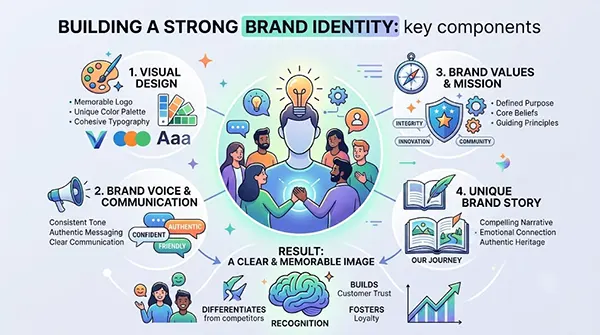
Brand identity is everything that a company builds to show who it is and how it stands apart from other competitors. It includes the brand’s logo, name, fonts, colors, personality, values, and communication style. All these factors help buyers not only to recognize and understand the brand but also what it stands for. These elements should also carry through to a well-designed website so visitors receive a consistent impression of the brand. All these factors help buyers not only to recognize and understand the brand but also what it stands for.
There are two parts of brand identity. The first one is the visual identity that people can see, like the logo, packaging material, fonts, website design, and colors.A responsive design helps maintain this visual consistency across different screen sizes. The second one is the brand personality. It includes brand story, values, purpose, and the way it communicates with its customers. Both of these parts help create a clear, recognizable, and memorable brand image.
The best way to understand what is brand identity is to consider a brand as a person. Just as a person has a name, likewise, a brand also has a name, story, values, personality, and uniqueness. This method is widely used by experts to explain brand identity. If a brand keeps presenting itself consistently, customers can easily recognize it and trust it.
What Is a Brand?
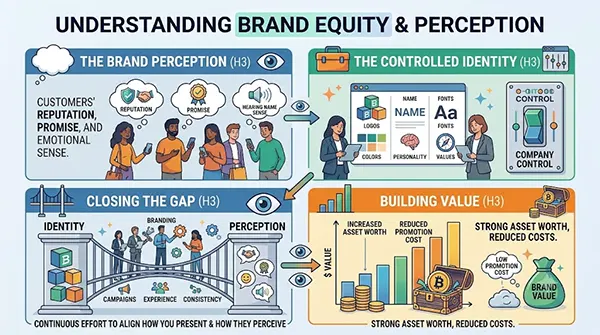
A brand is the whole perception customers have about a company: its reputation, promise, and the sense people get just by hearing its name. It remains in the minds of people and changes every time they interact with the company.
Brand identity is a part of that equation that the company controls. It is the company’s own choice about how the brand behaves, sounds, or looks.
Brand Identity vs. Brand Image vs. Branding
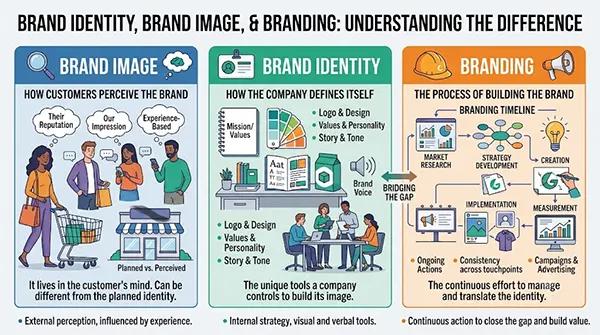
Here are 3 terms that people use interchangeably. However, they may sound similar but define different things. If you are confused about using them, it will lead you to a bad strategy.
- Brand image: This is how customers understand the brand. It directly comes from customers explaining each signal the brand shares through its touchpoints. A company can plan a premium identity, but if the customers’ experience shows poor service, it will narrate a totally opposite story. A mobile-friendly website is one part of creating a smoother digital experience.
- Brand identity: It is how the company wants to be seen. This totally depends on the brand name, visual identity, voice, and personality.
- Branding: This is a process of building, managing, and translating the brand. It is the main work of closing the gap between how you set the project identity and how customers see it.
Here is a table to understand the major differences in one go:
| Concept | Who controls it? | What it is | Example |
| Brand image | Audience | How people usually understand the brand | Customers love Nike for its motivational value. |
| Brand identity | Company | How the brand wants buyers to understand the logo, name, values, and voice. | Nike’s Swoosh with the “Just Do It” tagline and an athletic tone. |
| Branding | Company (ongoing) | Building identity and influencing imagery | Nike’s product experience, sponsorships, and campaigns over decades. |
Why Brand Identity Matters
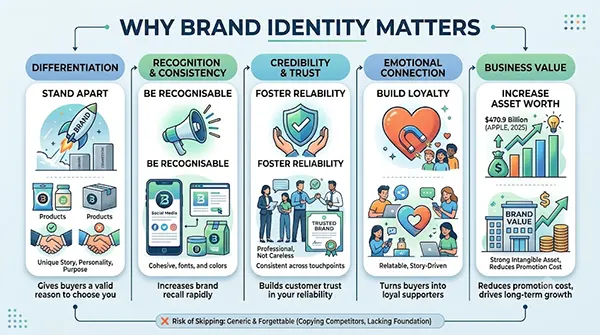
A clearly explained brand identity is just an impractical exercise; it needs a strategy that influences customers to trust, choose, and be loyal to your brand.
- Differentiation: Products and prices are very competitive in today’s cut-throat markets. The only thing that can make you stand apart is a unique identity. It gives buyers a valid reason why to go for your brand instead of choosing other competitors.
- Recognition and consistency: If you use the same logo, tone of voice, colors, and fonts across packaging, website, ads, social media, and customer support, it increases brand recognition rapidly. Choosing suitable web design software can help teams apply these elements consistently. Customers can easily identify the brand in one go, even without reading its name.
- Credibility and trust: A strong and professional identity shows its reliability. Inconsistency proves a brand is careless. Customers hardly trust careless brands when it comes to their money.
- Emotional connection: If you personify a brand using a story, values, or personality, it will allow audiences to relate to it in the same way they relate to people. Therefore, emotional attachment is something that can turn buyers into loyal supporters.
- Business value: You must note that a strong brand is an intangible asset of a company with remarkable worth. In Interbrand’s Best Global Brands 2025 report, Apple stands first in the ranking with an estimated $470.9 billion brand value, whereas the value of the 100 most valuable brands had only a combined $3.6 trillion. The conclusion is that a strong brand reduces the promotion cost because its identity does most of the work.
- The risk of skipping it: If you build identities by copying your competitors or run after short-term trends, these will become generic and forgettable. They lack a strong foundation, which is mandatory for long-term growth.
Key Elements of Brand Identity
The whole brand identity is a process and not just a single system. For companies building a broader digital presence, website development services can help translate brand requirements into a functional online experience. The core principles below work together. If you miss out on a single one, the brand identity will sound incomplete.
1. Brand Name and Tagline
The brand name is the very first thing that customers see, read, or hear, so it must be unique and easy to spell and memorize. A good brand name makes a permanent space in the mind and can even evoke emotions. The tagline supports it with a single-line summary of what the brand promises to deliver. Consider it the brand’s elevator pitch shortened into a few words, like Nike’s “Just do it.”
2. Brand Story, Mission, and Values
The brand story tells the time, place, and process of how the brand came into existence, including founders, struggle, cultural roots, and its turning points. The mission describes what the purpose is for today, the vision shows the direction it will proceed in, and the values define what it is for. Altogether, they build the form of strategic foundation on which every other principle is built.
3. Brand Personality
If you give a brand a human character like caring, bold, playful, or sophisticated, you make it relatable, which creates attachment. A branding scholar, Jean-Noël Kapferer, adds that personality fulfils a psychological function: it allows customers to identify with the brand being into it. A lot of brand strategists add personality archetypes like the caregiver, the hero, or the explorer as a shortcut to describe its character.
4. Voice and Tone
The tone and voice of a brand describe how the brand communicates. The most common style of communication includes respectful versus irrelevant, formal versus casual, enthusiastic versus matter-of-fact, and funny versus serious. A better way to note this down is to include a “We are like / we are not like” guide.
For example: We are like an experienced friend (“Here is the best way to solve this”); we’re not like rude management (“You are suggested to follow the prescribed steps”).
5. Visual Identity
Visual identity uses graphic elements that make it easy for people to recognize. It includes the logo, packaging, design, fonts, layouts, and product. Using visual identity consistently for a brand builds trust and enhances brand recognition. It is the most important part of a brand identity, if not the whole of it.
6. Products, Services, and Experience
The product itself becomes the identity. Customers observe a brand’s quality, uniqueness, and its products and services through their experience of buying and using them. Even a luxury identity fails when the product feels cheaper; a “customer-first” identity impression breaks if support is unavailable. The conclusion is that the product must deliver what it promises.
7. Sensory Identity (Optional)
Some brands take their identity to the next level: a fragrance in retail stores, petrichor in food, scent in hospitality, or even a unique texture in packaging materials. Sensory identity is completely optional; it plays an important role in retail, automotive, food, and hospitality. It helps customers make a powerful bond with the brand.
Brand Identity Design: How Visual Identity Comes Together
Brand identity design is the most important part of converting brand strategy into visually appealing assets. The strategy must answer the reason for the brand’s existence and identity with its design and answer how useful it is in the actual world.
Here is what a professional brand identity design project must have:
- Logo suite: Uses the same logo, icons, marks, and monochrome versions for multiple contexts.
- Visual elements and iconography: Custom patterns, designs, and icons.
- Color system: Primary and secondary color combinations should have the exact same values in RGB, HEX, Pantone, or CMYK.
- System type: With usage and hierarchy rules, it should include body typefaces and headings.
- Imagery rules: Filters, photography style, and dos and don’ts for images.
- Templates: The designs of social media posts, visiting cards, packaging material, and email themes. The same visual rules should extend to the site through thoughtful website redesign work when an existing experience no longer fits the brand.
All of this is mentioned in brand guidelines. It is a specific reference that explains all the roles, examples of using them correctly or incorrectly, and do’s and don’ts. Guidelines are helpful to maintain consistency in brand identity. It becomes very helpful when a lot of designers, team members, and agencies create content simultaneously.
Here are the four most important principles that a strong brand identity design follows:
- Consistency: Each asset must align with the core principles.
- Flexibility: Be available everywhere the same way, including an app, a website, a billboard, or even packaging. For larger organizations, enterprise web development can support consistent brand experiences across complex digital platforms.
- Relevance: Its appearance must match the target audience instead of just the founder’s choice.
- Simplicity: Some brand names and identity should be easy to recognize and have production at various quantities and sizes.
How to Build a Brand Identity: Step by Step
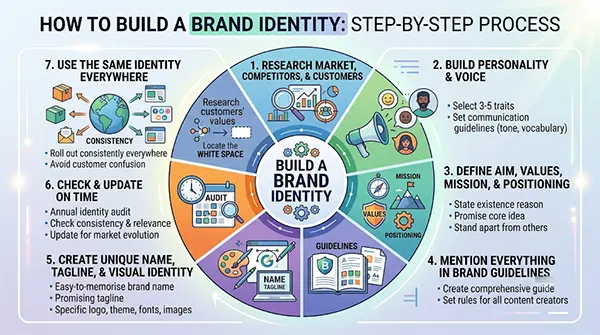
Creating a brand identity is a step-by-step process. Below are sequential points that most brand strategists and agencies follow:
- Research your market, competitors, and customers: Have complete research about your customers, their values, and presentation of your customers. Your main target is to locate the white space that no other brand has paid attention to.
- Build personality and voice: Select at least three to five of the most alluring human traits that define the brand. Now translate them into your communication guidelines: vocabulary, “we are like / we are not” examples, and brand tone.
- Define aim, values, mission, and positioning: Mention the reason for the brand’s existence, what it stands for, and how it stands apart from the rest. Every future decision will align with its foundation.
- Mention everything in brand guidelines: Write all the rules in a guide so that whoever is involved in content creation, whether internal or external, can define the identity in the same manner.
- Create a unique name, tagline, and visual identity: Spend time designing the tangible assets: an easy-to-memorise brand name, a tagline promising the brand’s core idea, and specific visuals for the logo, theme, fonts, and images. Businesses may work with a web design company to ensure the website reflects these choices.
- Check and update on time: Audit your identity annually. Make sure to check for inconsistencies, relevance to customers, and discrepancies in guidelines. Update your brand identity when the market evolves.
- Use the same identity everywhere: Roll out a brand’s identity consistently everywhere, including packaging, social media platforms, email, sales material, and display ads. If the site is being built from scratch, deciding between a custom website and a website builder can help align the platform with the brand’s needs. Using a brand identity differently will confuse customers rather than convince them.
Brand Identity Examples
Below are the top brand identity examples:
1) Nike shows that a small logo and a tagline are enough to show the whole identity. The swoosh plus “Just Do It” talks about empowerment, movement, and ambition within a second.
Key learning: Identity becomes the strongest part when each element describes a specific personality.
2) Coca-Cola is a live example of visual consistency power. With the same white and red palette, logo, and bottle design for over 110 years, it has created a strong brand identity consistently.
Key learning: When a brand uses its visual layers repeatedly, customers can easily identify a brand without even reading its name.
3) Amul, with its unique identity, is one of the most popular dairy brands in India. It has been using the same Amul girl mascot, the tagline “Utterly Butterly Delicious,” and familiar typography. Since 1966, Amul has used funny billboard ads with ongoing major events.
Key learning: A brand can remain popular without losing its identity for over decades. It can use the same logo, visuals, and tone while giving new and interesting messages.
Common Brand Identity Mistakes
Here are some of the most common brand identity mistakes that most people make. Thus, you must go through them and avoid repeating them in your case.
- Focusing only on the logo: A logo without any visible voice, personality, and value system is just a brand visual and not recognizable.
- Chasing trends or copying competitors: Copying the brand of your competitors will just lead to generic brands without any strong foundation or long-term existence.
- Not revisiting the identity: customers and markets develop with time, so if you do not audit your identity, it will gradually lose its relevance.
- Not consistent across all platforms: using a different tone in emails, a different logo on Facebook, and displaying ads without brand themes will erode trust and brand recognition in the market.
- No documented guidelines: Without specific and clear guidelines, every new agency or brand partner will interpret the brand in a different way, which will kill consistency.
FAQs
Q1) What does brand identity simply mean?
Brand identity means all the efforts a company takes to show its appearance in the market. It also includes logo, name, personality, tagline, and voice. The main aim is to create a unique identity so that customers can easily identify it.
Q2) What are the major parts of brand identity?
The most important parts of brand identity include its name, tagline, values, story, and mission; the products and customers’ experience; and visual identity, which also includes images, logo, color combination, and packaging.
Q3) How does brand identity differ from brand image?
The brand image depends on how people understand it and totally depends on customers’ experiences and explanations. Brand identity means how the company wants to be understood, and it all comes from the brand’s identity system, strategies, and guidelines.
Q4) Is your brand identity just about visuals?
No, visual identity is just a single layer. The whole brand identity also has intangible layers, which include values, personality, tone of voice, and story. Together, it makes a brand’s character, not just how it looks.
Q5) How many times should a brand update its identity?
Inspect it at least once a year just for relevance and consistency. Make sure to update it completely every five to seven years or when the market, audience, and business make a major move. Most necessary elements should be updated only in a timely manner and not recreated every time.
Conclusion
Brand identity defines how a brand behaves, sounds, and appears. Well, it is a pre-decided combination of name, personality, and voice that makes it stand apart in the crowd and informs people why it exists. A logo cannot do everything; therefore, everlasting brands need a complete, planned, and consistently applied strategy.
You need to make your foundation clear, add your intention, mention all the guidelines, and show up in the same way everywhere. Include all of this, and your brand identity will no longer be just a part of decoration but will start becoming one of your most important business assets.
Sources:
- The Power of a Strong Brand Identity: Definition, Importance, and Key Elements by the Branding Journal
- Interbrand: Apple retains No. 1 spot among 100 ‘best’ global brands by chainstoreage