Today’s digital society is full of links, from social media posts and email promotions to online advertisements, websites, and business cards. A simple and recognizable link can make a good first impression and help people to remember the address of your brand. That is where the vanity URL comes into play.
A long and generic URL may contain a sequence of random characters, numbers, tracking parameters, or complicated page paths. While such a URL might do well, it is complex to read, remember, and share. On the other hand, custom branded links are made up of a brand’s name along with some simple but meaningful word, creating a better-looking web address.
In this article, we will explore what is a vanity url, its uses, advantages for users, and even analyze best practices for minting vanity URLs.
- What is a Vanity URL?
- Vanity URL Meaning
- What Is a Vanity Link?
- Vanity URL vs Regular URL
- What Are Vanity URLs Used For?
- What Is a Vanity Page?
- Vanity Page and Vanity URL
- Benefits of Using a Vanity URL
- How to Create a Vanity URL
- Vanity URL Best Practices
- Common Mistakes to Avoid
- Does a Vanity URL Help SEO?
- Real-World Vanity URL Examples
- Vanity URL Platforms and Tools
- Frequently Asked Questions
- Final Verdict
What is a Vanity URL?
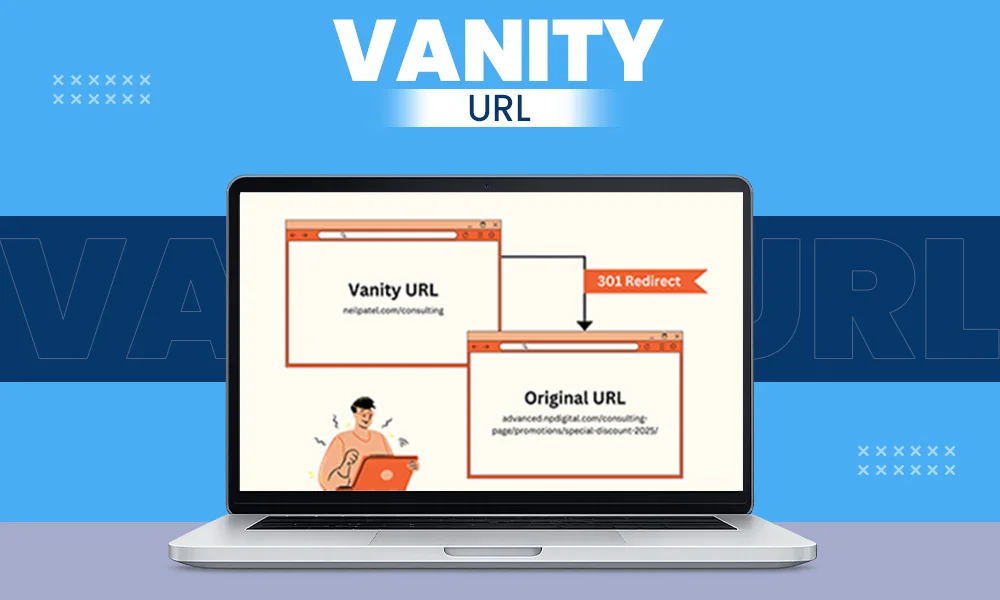
A vanity URL is a short custom-made URL that can be remembered, recognized, and shared easily. Unlike standard URLs, which are automatically generated and incorporate diverse combinations of numbers, letters, parameters, and other complicated elements, vanity URLs usually consist of simple and relevant words that simplify the complicated strings into a clear link containing the actual page identifier. For a broader understanding of how web addresses work, you can also explore what a website link is.
Vanity URL Meaning
The definition of a vanity URL is quite straightforward: a vanity URL is a web address that has been customized to become short, recognizable, and easy to memorize.
Instead of using a complex URL generated by a platform you may be using, you can create your own URL with a custom domain name or a catchy branded slug.
Simple Example of Vanity URL
To explain a vanity URL in simple terms, we can compare it to a generic web address and a customized URL.
Generic URL:
www.example.com/landing-page?id=58291
Vanity URL:
www.example.com/summer-sale
While the generic URL is functional in that it does what it was designed to do, it gets complicated because it has a lot of numbers and technical jargon and is more difficult to read and memorize. However, the vanity URL uses an informative phrase to tell website visitors what the page is about right away.
Moreover, a custom URL can help companies establish their brand. For instance, instead of having a long auto-generated URL, a company can use brand.com/demo for a product demo page. The branded URL is more recognizable, shareable, and related to the business.
What Is a Vanity Link?
You might be intrigued to know what a vanity link is and what it means. A vanity link is a web link customized to be short and easy to remember, and to give a clear idea of the brand, campaign, product, or a specific message. Mostly, it involves using the exact keywords, not random characters or complicated URL patterns.
Though vanity links and short links both help to simplify URL sharing, they do differ from each other. Most importantly, a shortened link is aimed at reducing the length of a URL:
short.ly/A7k92
Meanwhile, a vanity link aims at both shortening a URL and building a brand identity:
brand.com/guide
Vanity URL vs Regular URL
| Feature | Regular URL | Vanity URL |
| Structure | Might include a bunch of digits, complex paths, or IDs | Utilizes simple words |
| Readability | May be more difficult to comprehend | Easier to read |
| Memorability | Could be challenging to recall | Organized to be remembered |
| Branding | Limited branding potential | Provides an opportunity to enhance brand identity |
| Marketing | Can be ineffective while promoting | Can help to promote products and services |
| User experience | Destination is not always clear | Usually explains the destination of the page |
Standard URLs pose no serious problems at all. Numerous websites utilize configured URLs that are always successful. However, when businesses need an easy-to-use link, customized URLs seem to be a better option. If you are building or improving a website, understanding what makes a good website can also help you create a better overall user experience.
In brief, standard URLs focus on website architecture, while customized URLs place greater emphasis on simplicity and branding. A well-planned customized URL can make a webpage seem more approachable and provide additional opportunities for branding.
What Are Vanity URLs Used For?
Customized URLs are used when a business or creator wants to send a website address. As they can be created according to a certain brand, campaign, or need, customized URLs can be used for marketing campaigns both online and offline.
- Social Networking Accounts: Vanity URLs are handy for businesses and creators to redirect audiences toward their profiles on social networking sites, link-in-bio pages, or any particular social campaign.
- Email Marketing: Vanity URLs help enhance the appearance of links in marketing emails as they look cleaner and more professional.
- QR Code Promotion: QR codes can carry lengthy URLs, but by using vanity URLs as destinations, it will be easier to work with.
- Podcast and Video Marketing: The use of vanity URLs is especially preferable when links are pronounced rather than clicked, as is the case with podcasts and YouTube videos.
- Business Cards and Offline Promotions: Long URLs can appear messy on business cards, brochures, posters, and other printed items. An easy-to-remember vanity URL takes up less space and creates a clearer design.
- Event Registration Pages: Companies can create catchy vanity URLs for conferences, workshops, webinars, and other events.
In general, vanity URLs are proven to be effective when simplicity is a key factor. Whether being used online or offline, they enable businesses to create recognizable links that are easy to understand for users. A mobile-friendly website can further improve the experience for visitors who access these links from smartphones. Businesses can use website development services when they need a dedicated page or customized website structure for campaigns, products, or other business objectives.
What Is a Vanity Page?
A vanity page is a website developed specifically for a particular purpose that can be employed in connection with a particular person, campaign, brand, event, or product. Businesses requiring larger or more complex platforms can also consider enterprise web development. Unlike any other page on the website, vanity pages are usually customized according to the target audience and objective, containing special content, branding, messaging, and calls to action.
For instance, if a company wants to launch a new product and needs to inform potential customers, they create a page with relevant information about the product, promotion, testimonials, and a button for sign-up. The page can be accessed by following the simple and easy-to-remember URL: brand.com/new-product
Vanity Page and Vanity URL
Although both terms are associated with each other, there is a relationship between vanity page and vanity URL, as the former refers to the actual website and the latter implies a web address.
A vanity page is the webpage that is developed for the campaign and contains relevant messages, including materials and offers.
For instance:
Think about a business that launches a summer campaign and instead of redirecting visitors to its website’s homepage, creates a standalone landing page to feature:
- An eye-catching headline about summer promotion
- Offer details
- Product or service information
- Promotional images
- Customer advantages
- A strong call to action
This custom vanity web page and vanity URL form a good promotional route for the organization while enhancing the memorability of the link on social media, email, advertising, QR codes, and printed materials. The web design process also plays an important role when developing dedicated pages for specific campaigns, while professional web design services can help create pages that align with the campaign’s branding.
Benefits of Using a Vanity URL
A vanity URL makes links shorter, more catchy, and much easier to share. Whether you are running a marketing campaign, trying to raise awareness about the brand, or directing people to a certain landing page, you are likely to benefit from this customized option.
Key benefits of using a vanity url are:
Better Brand Recognition
A vanity URL makes it possible for companies to put their brand name, campaign name, or even a relevant keyword into the link. Take the example of brand.com/summer-sale. This URL is more recognizable than other generic URLs that are filled with random letters and numbers.
Easier to Share
Short links are easier to share and communicate. A branded link like brand.com/demo is much easier to express in an email, a social media post, or any other communication platform than a long link with lengthy parameters.
Higher Click-Through Rates
A good URL helps users have an idea of where the link will lead them. If a user understands the destination before clicking, they will feel comfortable interacting with the link.
Improved Trust and Credibility
The use of vanity URLs enables brands to increase trust and credibility among customers
Easier Marketing
The use of vanity URLs is very beneficial in offline marketing, especially because they are easy to write down. A business can use a vanity link on their business cards, posters, brochures, billboards, flyers, etc.
How to Create a Vanity URL
Here are the steps to create a Vanity URL
Step 1: Pick Your Destination Page: You have to determine which page you would like users to visit.
Step 2: Pick Something Catchy: Pick a short and relevant keyword or phrase like /price, /demo, /offer, etc.
Step 3: Check Availability: Make sure the keyword or phrase you have chosen is available and does not clash with an existing webpage.
Step 4: Set Up the URL: You have to configure your custom URL to direct users to the required webpage; this is usually done via a redirect.
Step 5: Test the URL: Check if your custom URL works on both desktops and mobiles.
Step 6: Promote the URL: Make sure to include your custom URL in your offline promotional materials.
Businesses should also consider their web hosting setup and website maintenance when managing website URLs, redirects, and pages.
Vanity URL Best Practices
- Keep Icons Short: Avoid unnecessary numbers, letters, or punctuation marks.
- Make it Clear: The URL should tell users what they will find when they reach the link.
- Use Basic Vocabulary: Choose words that are easy to understand and pronounce.
- Stay Away from Silly Characters: Avoid using unnecessary numbers, special characters, or complicated URL parameters in a vanity URL.
- Use Lowercase Letters: Lowercase URLs prevent confusion because some servers and systems might confuse URLs in uppercase and lowercase.
- Use Hyphens When Needed: Using hyphens between letters increases readability when the vanity URL consists of several words.
- Make a URL Easy to Pronounce: This is especially important regarding radio talks, podcasts, television commercials, speeches, etc.
- Redirect Carefully: If a vanity URL redirects to another page, make sure that the redirect is correctly set and that the redirect chain is not long.
Common Mistakes to Avoid
Creating a vanity URL is not difficult, but some things that should always be avoided.
- Making the URL Lengthy: When vanity URLs become too long and complicated, they lose their purpose
- Using Hard-to-Understand Abbreviations: While brand.com/smtr video creation is definitely shorter, people may not be able to understand what it means.
- Changing URLs Too Often: After the vanity URL became well-known, changing it would lead to broken links and loss of audience
- Neglecting mobile audience: Mobile phones are a means of sharing URLs. They should be as easy to memorize as possible, and not complicated.
- Using deceptive URLs: A vanity URL should properly represent what the page is about. Do not use a link that tells one story and leads to another page. When significant changes are required across a website, a website redesign should also account for existing URLs, redirects, and the user experience.
Does a Vanity URL Help SEO?
Vanity URLs can be beneficial for SEO indirectly by providing descriptive and clear URLs; however, creating a vanity URL alone does not ensure better rankings.
Search engines can use the words in the URL as contextual signals, while influencing the overall performances in SEO. Several factors such as quality and relevance of content, linking, technical SEO, backlinking, and UX have a great impact on SEO practices.
For instance:
instance.com/digital-marketing is more descriptive compared to instance.com/page?id=1837
The first URL gives better context about the page both to users and search engines.
Nevertheless, you should not create a vanity URL only for SEO purposes. The URL should work as part of a well-structured website rather than being considered separately from the site’s content and design. Businesses evaluating their options can also compare a custom website vs. website builder before deciding how much control they need over their website structure.
Real-World Vanity URL Examples
Brands, marketers, organizations, and other groups often use vanity URLs to promote certain links. The URL can be adapted to fit the needs of a specific campaign, platform, or product, making the purpose of the site clear for visitors.
Brand campaign example
A company engaged in seasonal promotional activities can create a catchy link like:
brand.com/summer
Instead of long, cumbersome campaign links, the company can use a short one in its promotional materials.
Social Media Profile Example
Creators and businesses can employ a vanity URL to lead users to a social media profile or a custom social landing page.
For instance: brand.com/instagram
In this case, the URL suggests its content explicitly and is convenient to use in a website profile account, signature, marketing tool, or oral promotions.
Event Registration Example
Conference, seminar, and webinar organizers can create a unique vanity URL for event registration.
For instance: brand.com/register
It is way easier to recall and share than a long registration URL provided by the hosting platform. The vanity URL can be included on invitations, flyers, event posters, etc.
Product Promotion Example
Businesses selling products online can also use e-commerce website development to create dedicated product and promotional pages. A company that is starting a new product launch can develop a promotional website with an easy-to-recall vanity URL like:
brand.com/new or brand.com/product
After that, the link can be used in ads, social media, email marketing, QR codes, and videos, among others. Given that the URL is short, potential customers will get the link and understand what they can learn more about.
These cases demonstrate that a vanity URL is a great tool in the promotion campaign, making it recognizable, convenient to remember, and easy to share both in digital and real-world marketing.
Vanity URL Platforms and Tools
Creating a vanity URL does not need sophisticated technical knowledge. You may rely on domain registrars, URL shorteners, and any tools that have been installed on your website and content management system.
Branded Domain Registrars
Domain registrars grant businesses an opportunity to create personal domain names. Using one’s own memorable branded domain is the basis for the approach to vanity URLs.
Short URL Services with a Custom Domain Name
Lots of short URL services allow businesses to connect with the domain of their choice in spite of the default one.
CMS and Website Redirect Tools
If clients use any content management or website system to run their site, they will have the opportunity to edit and customize URL slugs or create redirects from one page to another.
Frequently Asked Questions
What is a vanity URL?
The vanity URL is a custom link formed to keep it short, simple, and catchy. With the help of these links, one may give the name of a brand, a keyword, a campaign name, or any other simple phrase instead of a lengthy web address.
What is a vanity link?
The vanity link is a word often used in marketing and advertising. Essentially, its meaning is the same as that of the vanity URL which means that it is also aimed at making web links memorable and easier to use or pass around.
Are vanity URLs different from shortened links?
Although both types of links share the aim of simplifying long links, there is a difference between the two. The main difference lies in the idea of personalization that vanity URLs use, while shortened ones make URLs shorter.
Does using vanity URLs help with SEO?
Vanity URLs can help users to understand and share the webpages easier. Describing URLs can offer a better idea about what the page is about, but using a vanity URL does not mean higher rankings for the page. The SEO result greatly depends on a variety of aspects like content quality and relevance, technical SEO, and backlinks.
Is it possible to create a vanity URL for a marketing campaign?
Of course! In fact, vanity URLs are widely utilized for marketing campaigns. For instance, a company running a special offer can utilize brand.com/summer to direct users to a specific campaign landing page.
Can the vanity URL be combined with a QR code?
Yes! The vanity URL can act as a target for the QR code. This allows handling the campaign more effectively, especially if the vanity URL is set to redirect to the necessary landing page.
Final Verdict
A vanity URL refers to an easy, customizable link made to be understood or memorised easily, while closely linking back to a certain brand, campaign, product, or a particular webpage on the internet. In contradiction to long or complex URLs, vanity URLs use simple expressions that make links easy to remember and find.
In addition to making links cleaner, vanity URLs enhance brand awareness and usability when used in marketing efforts. Simple URLs are easier to share via social networks or emails, easier to communicate in offline advertising, and easier to notice in marketing campaigns, QR codes, events, and advertising materials.
To make your links easier to use, it is worth creating a simple branded vanity URL for your website, landing page, or any other campaign. When creating a link, make sure it is meaningful and relevant for your potential customers.